/latest-issue

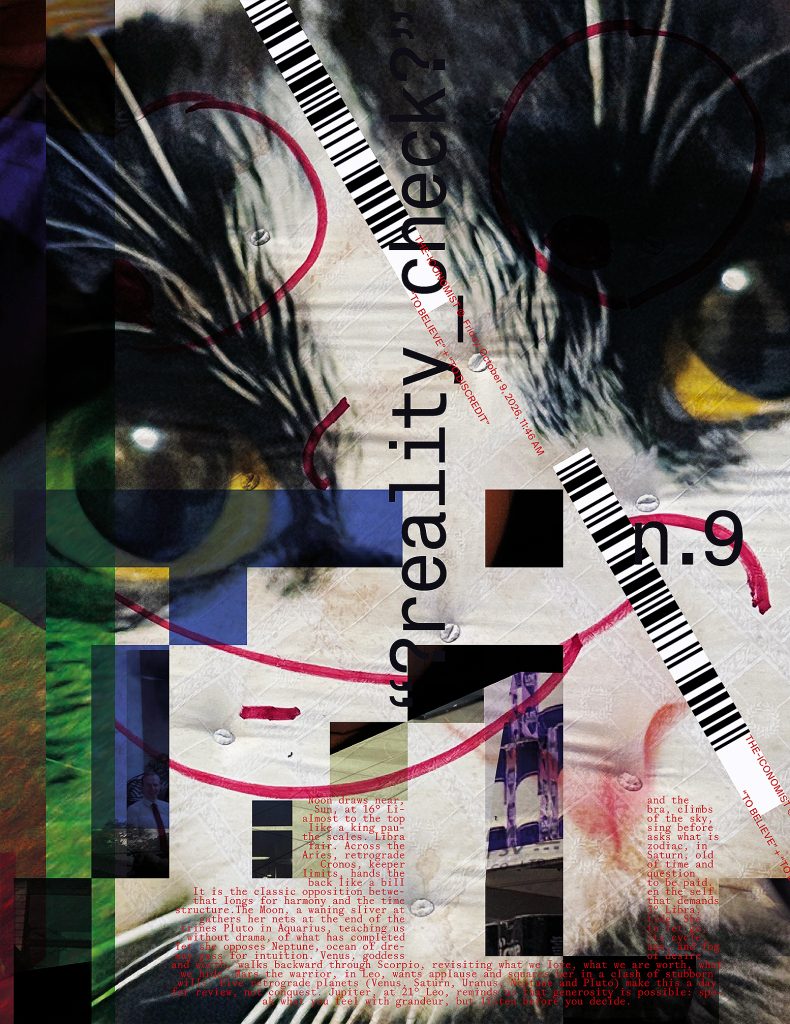
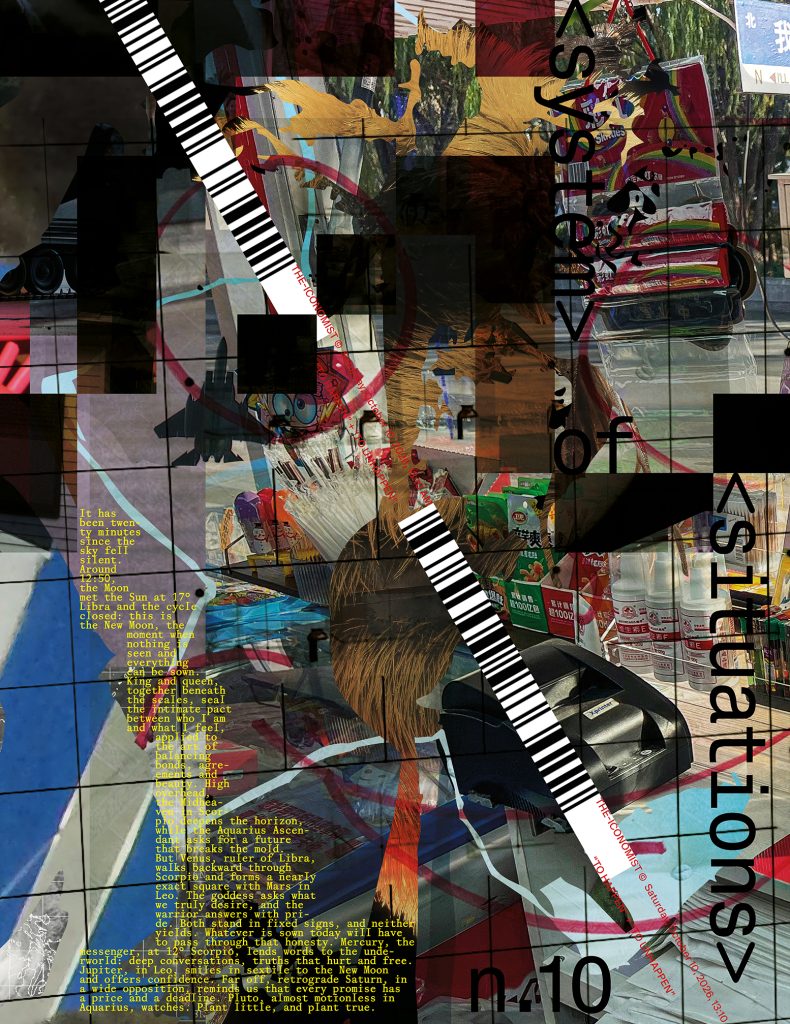
Nº 8 — AFTER-IMAGE. The eighth issue of THE-ICONOMIST, titled To propose / To recreate, takes as its point of departure Édouard Glissant’s notion of the aprèzan: the present as a living interval between destruction and regeneration. From this idea unfolds a reflection on what it means to create in an era where images multiply endlessly, and where visibility itself has become a form of capture. In a world increasingly shaped by artificial intelligence, every image we share becomes data; analyzed, categorized, and reabsorbed into vast systems of recognition. Within this landscape, the publication suggests a different kind of response: a digital craftsmanship that moves against automation, exploring how the deliberate act of cutting, layering, and reassembling images can function as both creation and camouflage, a way of disrupting the smooth readability demanded by machines. To propose / To recreate unfolds as a moving terrain of visual thought, which is part proposal, part reconstruction. In addition to experimental texts created by THE-ICONOMIST, the edition also features selected excerpts from authors such as Naomi Klein, Thomas Pynchon, Mark Fisher, Olga Tokarczuk, Fernando Birri, among others.
VOL. II — IMAGE BANK (2024-present) The second volume of THE-ICONOMIST, launched in 2024, draws from Scott Watson’s idea that “we are all image banks” to explore the appropriation of digital images as a way of commenting on the world. Its editions are built from collections sourced from image banks, expanding the project’s research on contemporary visual flows and the possibilities of intervention within this vast collective repository.
/input

This zine brings together images captured by Google Street View along the entire route of the Unidos da Tijuca samba school parade during the 2015 Carnival in Marquês de Sapucaí, Rio de Janeiro. That year’s theme, Um encontro marcado no tempo (A rendezvous marked in time), paid tribute to carnival designer Clóvis Bornay. Here, however, Carnival does not appear as a spectacle or an organised celebration. What we see is a party captured by a system that does not recognise choreography, narrative or festive time. Sapucaí is recorded as a road, infrastructure, route. A path to be mapped. Bodies in motion, floats and crowds are fragmented by an automated, intermittent vision, incapable of keeping up with the temporality of Carnival. What should be continuous appears in glitches, jumps and interruptions. Excess becomes noise. The images do not document the parade; they highlight the limitations of a device designed for empty streets, not for bodies in celebration. In this displacement, Carnival is reduced to data, a route, an operational record. There is no choice of framing, no aesthetic intention, only capture. The gaze does not participate, does not interpret, does not celebrate. It operates. The parade ends up becoming an involuntary choreography between popular celebration and mapping technology, revealing how even a collective, local and ephemeral ritual can be absorbed by global recording systems. This zine observes what happens when Carnival is seen through the eyes of someone who doesn’t know how to party.
13x20cm, 84pp., saddle-stitched binding. Shipping worldwide.
Buy in print$20
Buy digital version $2.99
/extensions

STAYNONSTOP is a photobook consisting of a selection of 130 images generated by artificial intelligence. The images are accompanied by fragments of artists’ texts from different sources. The name of the book comes from a reflection on how addictive these image production processes through artificial intelligence can be, like everything these days. By placing these images in confrontation with the text fragments, we try to force new readings and the creation of new contexts different from the ones used to generate the images.
/database
/activity
News from Switzerland: THE.ICONOMIST #issue7 and the zine F is for FRAGILITY were shortlisted for the Rosmarie Tissi Award in graphic design in the MA-g (Museum of Avant-garde) Awards. These publications will now become part of the institution’s contemporary collection.
“We always think of the imagination as the faculty that forms images. On the contrary, it deforms what we perceive; it is, above all, the faculty that frees us from immediate images and changes them. … Imagination is essentially open and elusive. We could say that a stable and completely realized image clips the wings of the imagination. It causes us to fall from the state of dreaming imagination that is not confined to image, and that we may call imageless imagination, just as we speak of imageless thought.”
— Gaston BACHELARD, in Air and Dreams (1943)
28 July 2025, 11:20 AM [PROSE] A DRESS GREW ITSELF
894 WORDS, READING TIME: 4m58s [read]
[INPUT] I TOOK A PHOTO AND I FORGOT TO FEEL.pdf
2025, research for upcoming project, 35p., 1080×1920 each [view]
/to-watch
THE WORLD AS A STAGE is based on images from public security cameras. Evoking William Shakespeare‘s famous phrase, the title suggests that everyday life is constantly under observation, turning us all into actors who play our parts in front of an invisible audience. Just as in the poem “All the World’s a Stage”, where each person plays their part in the great play of life, modern surveillance puts us on a global stage, where our every move is recorded and monitored. This film explores this dynamic, revealing how the constant presence of cameras alters our perception of privacy and behavior. This film is an extension of #issue5 of THE ICONOMIST released in July conceived as a multi-channel digital installation, in which four cameras in different locations are observed simultaneously, with the commentary coming from this control room. “The World as a Stage” also features voiceover fragments of Shakespeare’s poem, the text that opens the magazine issue and a collection of headlines from news websites forming a poem about digital everyday life. A film by THE-ICONOMIST, 11m06s, color, sound [watch]
/play

rEDLines is a virtual automated writing installation that subverts the logic of the journalistic headlines to reveal their flaws, excesses, and poetic deviations. Hosted on THE-ICONOMIST, the work operates as a language machine, firing off fragments of text that recombine incessantly, creating impossible headlines, news from a fictional or distorted world, echoes of a collapsing reality. Playing with the double meaning of the term, redlines also refers to corrections, censorship, or limits drawn in red, the installation proposes a space of tension between language, truth, and fiction. Each phrase that appears on the screen carries the weight of a possible headline, but also the lightness of error, chance, and productive failure.
/research


At what scale should we consider the lives of Black Americans? For more than thirty years—starting while he worked as a cinematographer—Jafa has sought to answer that question, compiling notebooks with clippings from magazines, newspapers, and advertisements. Images of Mickey Mouse and Sojourner Truth intermingle with pictures of insects and astronomical phenomena; Black athletes, musicians, and artists; skulls and mutilated bodies. While each image stands alone, together they convey the shared vocabularies and collaborative practices the artist considers central to Black cultural production. Jafa’s notebooks, copies of which are presented here, testify to the complexity and beauty of Black life in the United States.
“Taking its name from economist Gilson Schwartz’s 2006 neologism ‘Iconomy’ while also nodding to longstanding news weekly The Economist, THE-ICONOMIST questions our relationship with images in this era of image saturation with each issue using verbs as its themes.”
— MAGCULTURE.com
“THE-ICONOMIST’s latest issue is hectic and “suffocating” in its use of online image banks. The magazine has never really operated within the requirements of a conventional magazine. This isn’t just because the issues don’t have any advertisements or an ISBN number, or even that it doesn’t have a website that can be indexed by Google. The magazine defies a traditional editorial approach at every turn.After its first four issues’ focus on AI-generated visuals, the magazine has returned with its fifth edition — a printed exploration of surveillance in the digital age.”
— ELLIS TREE, It’s Nice That